


AI Infant Mortality Case Management Modernization Framework
Our Healthcare client needs a modernized case management framework that is designed to improve infant mortality reviews through artificial intelligence and cloud-based data systems. By utilizing Snowflake and Azure Government Cloud, our project created a secure environment that automated file assembly and identified public health trends while strictly adhering to HIPAA and privacy regulations.
Key security measures include air-gapped data zones, automated de-identification, and "canary" monitoring to prevent unauthorized access to sensitive patient information. AI agents have assisted with summarizing complex cases and risk scoring, but all automated outputs remained subject to mandatory human oversight.
This "data modernization engine" was built to scale, providing a foundational architecture that can be applied to other critical clinical outcomes in the future. This initiative concluded with a transition to state-managed operations, ensuring long-term governance and improved decision-making for public health officials.
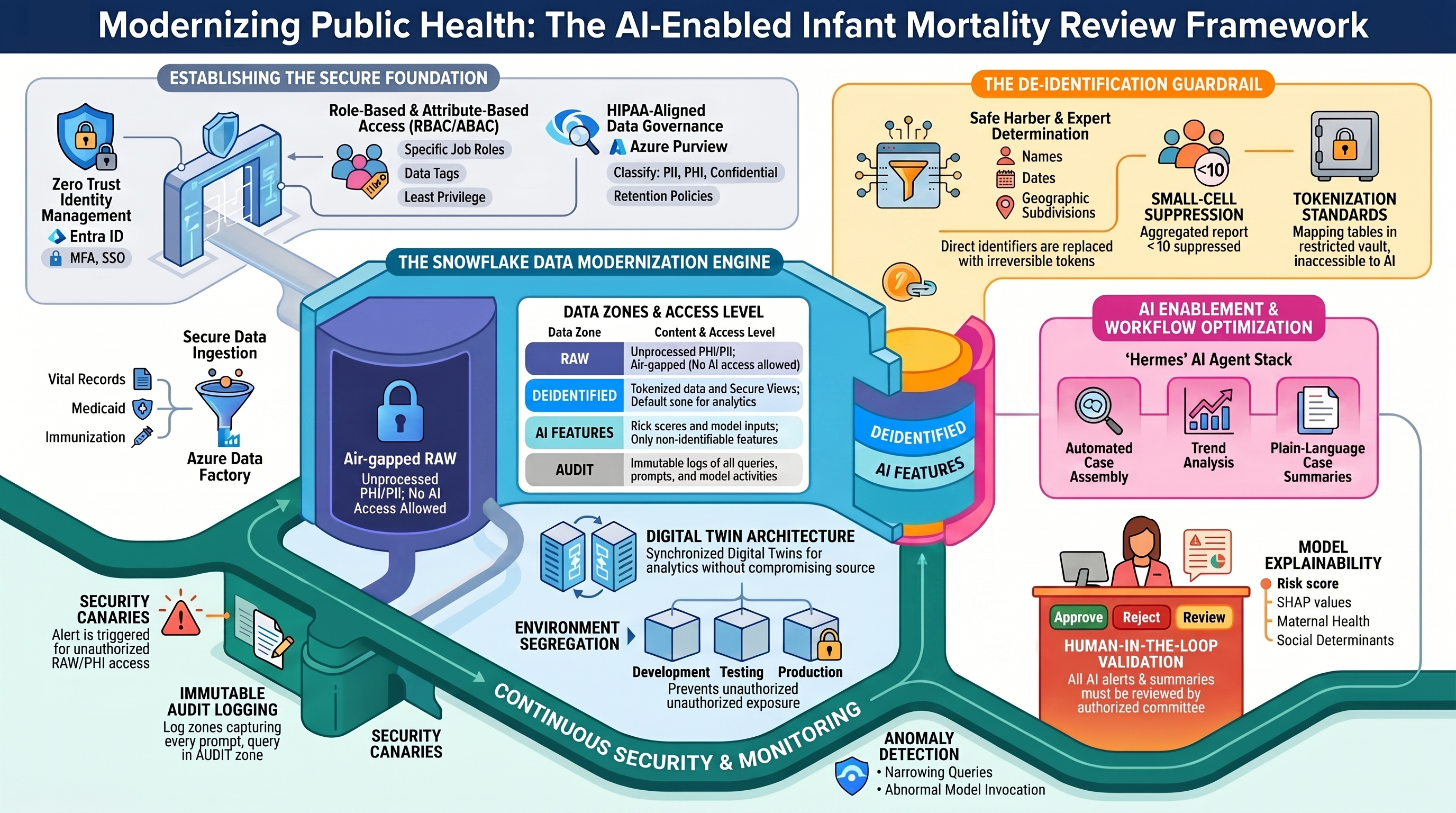
The modernization of our healthcare client's infant mortality review process aimed to establish a secure, cloud-first, HIPAA-compliant data and artificial intelligence (AI) framework. This initiative focused on transforming how case files are assembled, governed, and analyzed to improve public health decision-making.
Project Objectives and Scope
- Modernize Data Architecture
- Utilize Snowflake as the enterprise data platform to securely aggregate and analyze infant mortality data.
- Implement Cloud-First IAM
- Establish a modern Identity and Access Management (IAM) framework using Microsoft Entra ID (formerly Azure AD) for healthcare client's authorized staff and committee participants.
- Supports Single Sign-On (SSO) and multi-factor authentication (MFA).
- Utilizes Role-Based Access Control (RBAC) and Attribute-Based Access Control (ABAC)
- Establish a modern Identity and Access Management (IAM) framework using Microsoft Entra ID (formerly Azure AD) for healthcare client's authorized staff and committee participants.
- Establish Data Governance
- Implement enterprise-wide governance, sensitive data cataloging, and HIPAA-aligned data minimization controls.
- Enable AI-Ready Workflows
- Create secure, governed, and explainable AI capabilities to assist in case summarization and trend identification.
Technical Solution Design
- Cloud Ecosystem
- The platform is built on the Azure Government Cloud, utilizing Azure DevOps for CI/CD and Azure Purview for data discovery and classification.
- AI Framework
- Leverages the Hermes/OpenClaw multi-agent stack for automated case assembly and risk modeling.
- Data Zoning
- Snowflake architecture is organized into distinct zones — RAW, DEIDENTIFIED, AI_FEATURES, and AUDIT — to enforce strict isolation of sensitive information.
-
- RAW Zone: Air-gapped area where sensitive patient information is stored with no direct AI access.
- DEIDENTIFIED Zone: Contains tokenized datasets and secure views for analytics.
Security and Privacy Safeguards
- Zero PHI Access Policy
- A foundational principle ensuring no raw Protected Health Information (PHI) is accessible to AI agents, analytics consumers, or committee participants without audited approval.
- De-identification Standards
- Employs Safe Harbor and Expert Determination methods to remove identifiers and apply small-cell suppression (masking groups < 10)
- Security Canaries: Automated monitoring and alerting mechanisms designed to detect:
- Unauthorized access to RAW datasets
- Attempts at re-identification or "narrowing" queries
- Suspicious data exports or AI prompt misuse
- Human-in-the-Loop
- All AI-generated outputs, such as case summaries and risk alerts, remain subject to mandatory human review and validation before use.
AI Use Cases and Benefits
- Automated Case Management
- Streamlines case file assembly and generates concise summaries for review committees
- Analytical Insight
- Enhances the ability to identify trends, patterns, and missing documentation across disparate data sources.
- Explainability
- Risk models are designed to provide plain-English explanations for their outputs, ensuring transparency for decision-makers.
Implementation Roadmap
The project is structured into seven phases, moving from initial discovery and governance to IAM implementation, Snowflake deployment, data integration, and finally, AI pilot workflow development and operational transition. Success is defined by reduced manual administrative burden and a robust foundation for governed public health innovation