


Architecting an Azure-Native Predictive Maintenance System
We design a real-time predictive maintenance system for our energy client's distributed assets (like wind turbines or substations). As we design the architecture for this new AI application from scratch, we had to decide between a monolithic deployment and a microservices architecture.
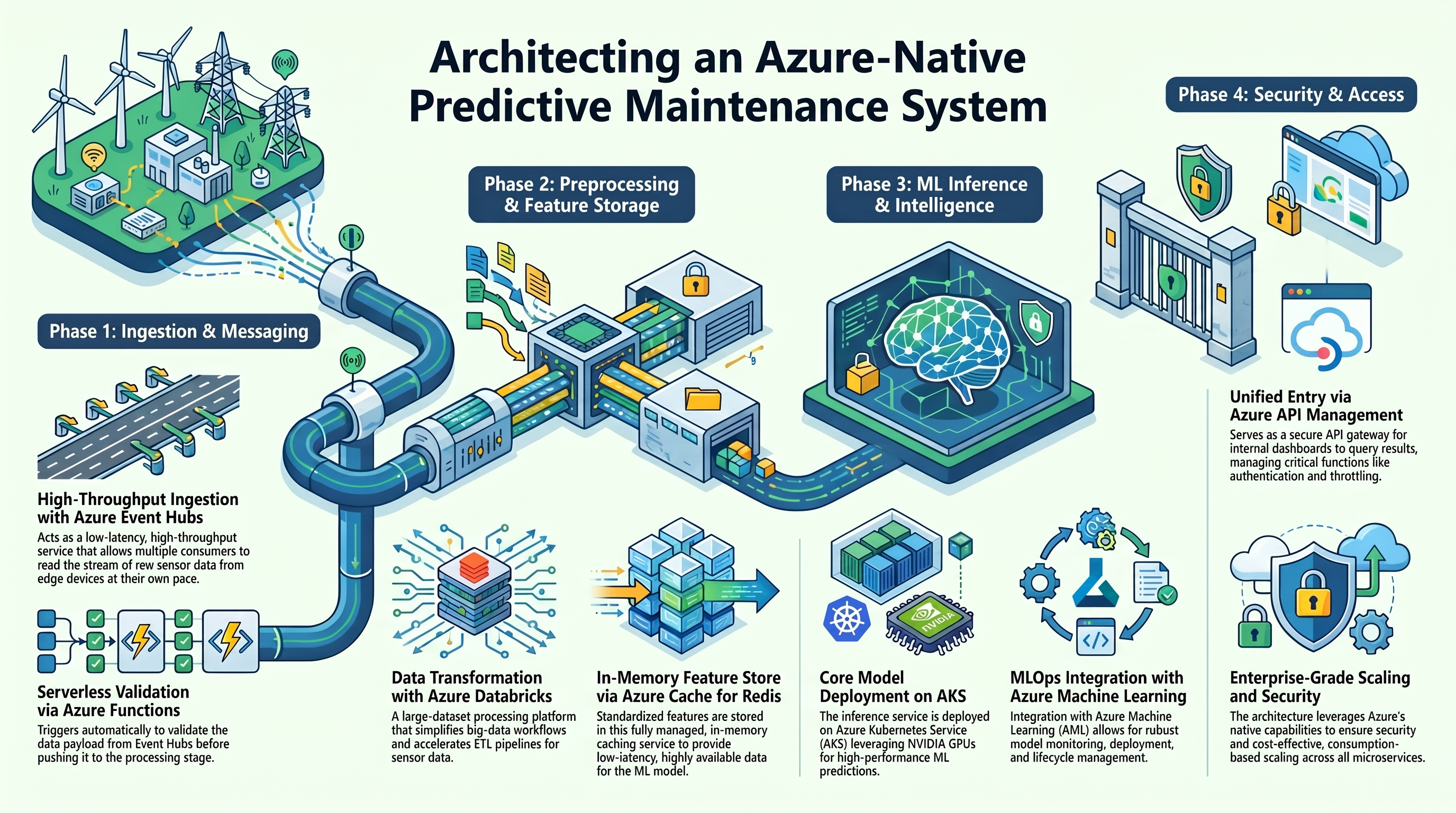
- DECISION (MICROSERVICES)
- A microservices architecture was selected leveraging Azure Kubernetes Service (AKS) for its scalability, resilience, and developer velocity. This allowed us to decouple the high-volume data ingestion from the high-performance ML inference.
- KEY SERVICES DEFINED IN AZURE
- 1. Ingestion/Messaging (Azure Event Hubs & Azure Functions)
- Raw sensor data from edge devices feeds into Event Hubs (is a low latency, high throughput event ingestion service that allow multiple consumers to read the same stream at their own pace) for high throughput. A serverless Azure Function then triggers to validate the payload and push it to the next stage.
- 2. Preprocessing & Feature Store (Azure Databricks & Azure Cache for Redis)
- Azure Databricks (is a ‘large datasets’-processing data engineering platform that simplifies big‑data workflows, accelerates ETL pipelines) handles large-scale data transformation. The resulting, standardized features are stored in Azure Cache for Redis (is a fully managed, in memory caching service to store frequently accessed data in memory) to act as a low-latency, highly available feature store for the model.
- 3. Inference Service (Azure Kubernetes Service - AKS)
- The core (model) service, deployed on AKS and leveraging NVIDIA GPUs. This allows us to use Kube-native scaling and easily integrate with Azure Machine Learning (AML) for model deployment and monitoring.
- 4. API Gateway (Azure API Management)
- Provides a single, secure entry point for the client's internal applications and dashboards to query results, managing authentication and throttling.
- 1. Ingestion/Messaging (Azure Event Hubs & Azure Functions)
- BENEFIT:
- Our Azure-native approach ensures enterprise-grade security, leverages Microsoft's MLOps capabilities through AML, and provides cost-effective, consumption-based scaling.