


Smart Grid Resilience: Automating Power Line Inspection with Azure AI
Our energy client wants to use AI (Computer Vision [CV] and/or Diffusion) to automatically identify defects (like cracks or corrosion) on high-voltage power lines from drone imagery. We provided the solution leveraging the maturity and reliability of Azure Machine Learning for enterprise-grade Computer Vision (CV) workloads
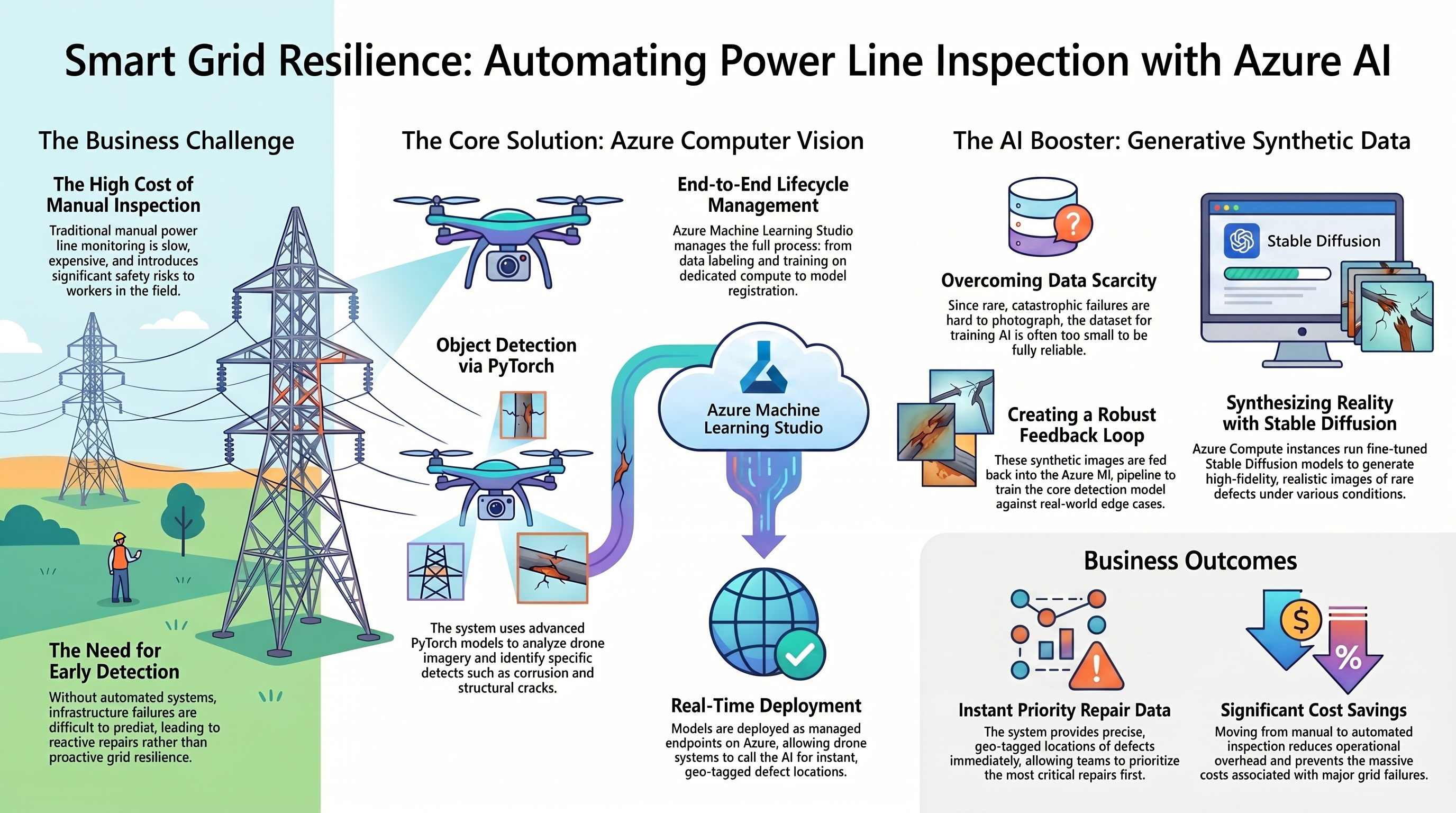
- THE BUSINESS PROBLEM
- Manual inspection is expensive, slow, and risky. We need an automated, reliable system to detect infrastructure failure early.
- THE AI SOLUTION (COMPUTER VISION - OBJECT DETECTION)
- We use a PyTorch model (uses tensors; a core strength) for object detection.
- Deployment
- We leverage the Azure Machine Learning Studio workspace. This allows us to handle the full lifecycle: data labeling, model training on dedicated Azure compute, model registration, and then deploying the model as a real-time endpoint (managed endpoint on Azure) that the drone system can call.
- Outcome
- The system provides precise, geo-tagged locations of defects (cracks, corrosion) instantly, prioritizing repairs and leading to significant cost savings and improved grid resilience.
- WHERE GENERATIVE AI (STABLE DIFFUSION) COULD HELP (THE MICROSOFT/AZURE ANGLE)
- Problem
- Our defect dataset is small, or we lack images of rare, catastrophic failures.
- Solution
- We use Generative AI techniques, leveraging capabilities available through Azure AI Content Safety (to ensure generated images are safe) or running a fine-tuned Stable Diffusion model on Azure Compute Instances. The goal is to synthesize realistic, high-fidelity images of defects under various conditions.
- Outcome
- These synthetic images are then fed back into the Azure Machine Learning pipeline to make the core Computer Vision (CV) defect detection model much more robust and reliable against real-world edge cases.
- Problem