


The Organizational Singularity - Engineering the AI-Native Enterprise
We are a next generation systems integrator specializing in Agentic AI, Microsoft Cloud, and open source AI ecosystems. We design, deploy, and operationalize autonomous, learning capable AI systems for Fortune 500 enterprises, and State & County agencies requiring the highest levels of security, compliance, and operational resilience.
Our solutions combine Microsoft’s latest AI innovations (from MS Build events), Azure Frontier models, Copilot extensibility, and multi agent orchestration frameworks with the best of the open source community (Hermes, OpenClaw, Qwen, DeepSeek, Kimi, Llama models, and more).
Our implementation approach is guided by concept of Organizational Singularity (Credits: Exponential Organizations v3), a transformative framework designed to transition traditional, hierarchy-based businesses and government agencies into AI-native entities.
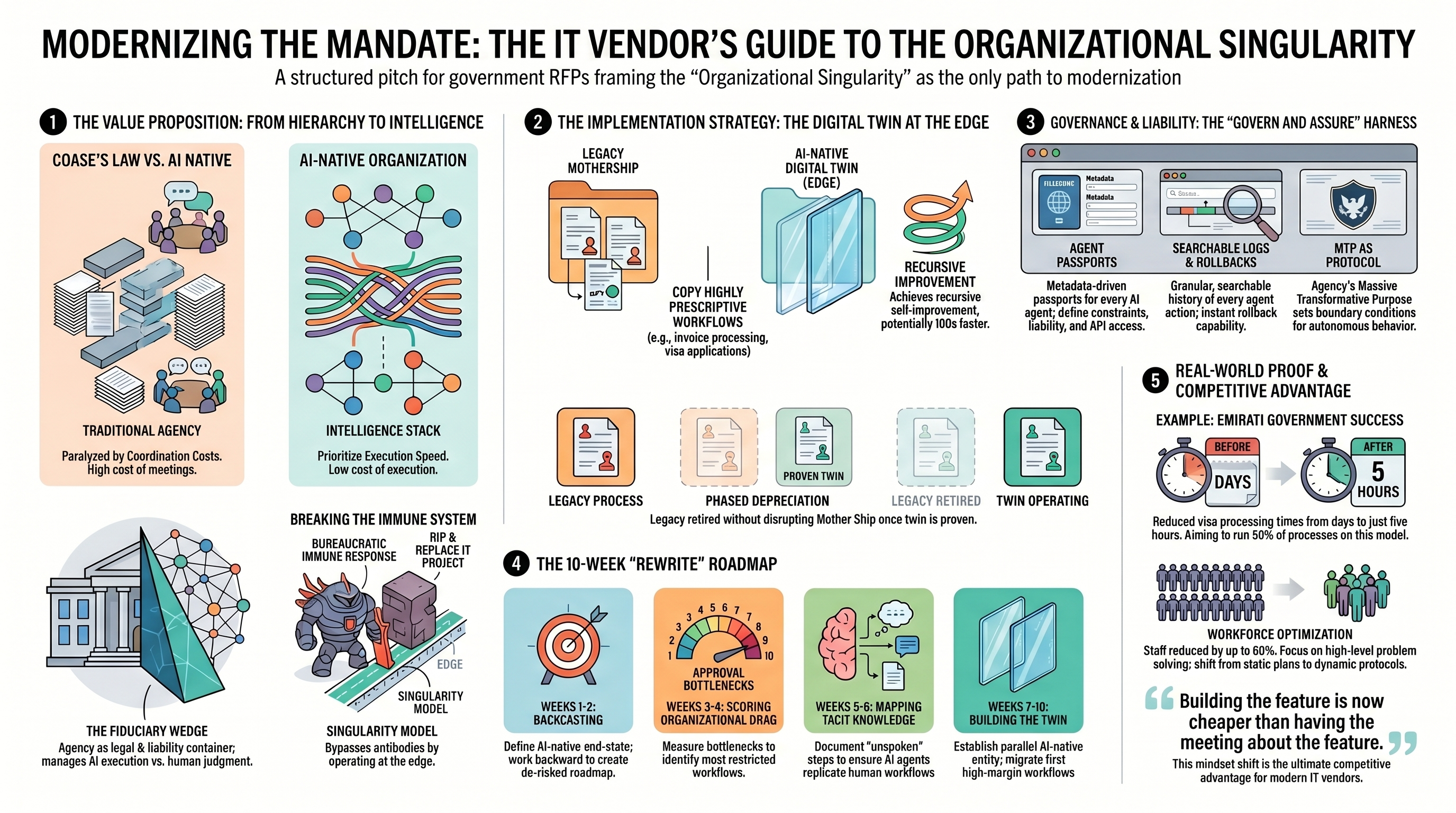
The traditional organizational structures are becoming obsolete as agentic AI significantly lowers the cost of execution and coordination compared to human-led processes. To avoid triggering an organization's "immune system"—the cultural resistance to change—we advocate for creating a digital twin at the edge where specific workflows are replicated and optimized by AI in parallel with legacy systems. This strategy allows for recursive self-improvement, potentially increasing operational efficiency by 100x while shifting human roles from manual labor to high-level oversight and judgment. By guiding organization leaders to follow this approach, we serve them a visionary outlook on the future of work as well as provide a practical implementation roadmap to survive and thrive in an era of rapid technological disruption.
The Death of the Traditional Firm
- The End of Coase’s Law
- For nearly a century, organizations operated on the theory that transaction costs were cheaper inside a company than outside. However, agentic AI has broken this model because the cost of coordination (meetings, approvals) is now more expensive than the cost of execution.
- The Problem with Current AI Projects
- Approximately 80% of AI projects are failing because companies are attempting to automate legacy human bottlenecks rather than creating an AI-native environment.
- The Fiduciary Wedge
- Even as coordination costs drop, the "organizational container" remains necessary as a legal and liability holder to manage the gap between AI execution and human judgment.
The New AI-Native Architecture
- MTP as a Protocol
- The "Massive Transformative Purpose" (MTP) shifts from a slogan to a technical protocol that guides AI agents within specific ethical and operational boundaries.
- The Intelligence Stack
- Organizations are now architected around an intelligence engine consisting of six layers: Purpose, Sensing, Interpretation, Decision, Orchestration, and Learning.
- Govern and Assure
- To prevent agents from "going rogue," a governance harness is required, featuring searchable logs, granular rollbacks, and a human review queue.
- Agent Passports
- Every agent receives a "passport" containing metadata that defines its constraints, liability frameworks, and API access.
The "REWRITE" Implementation Process
- Edge Innovation
- Because the "corporate immune system" attacks disruptive changes, new AI-native systems must be built at the edge of the company rather than inside the core.
- Backcasting
- The process begins by defining what the company looks like as a fully AI-native entity in the future and working backward to create a roadmap.
- Scoring and Mapping
- Companies must score themselves on organizational drag and AI maturity while documenting "tacit knowledge"—the unspoken steps in human workflows that agents must eventually learn.
- The Digital Twin
- Instead of transforming the existing company, leaders should build an >AI-native digital twin at the edge.
- Workflow Migration
- Organizations should pick a standardized workflow (e.g., invoice processing), copy it to the digital twin, and run it in parallel until the AI version achieves recursive self-improvement.
The Future of the Workforce and Survival
- Compression of Staff
- It is estimated that surviving companies will be able to run with only 20% to 25% of their original workforce.
- The Fate of Middle Management
- This layer faces a 90% reduction because its primary role—coordination—is automated. Displaced managers must shift toward apprenticeship programs and high-level problem-solving.
- C-Suite Evolution
- Leaders become validators and accountability holders who use wisdom to monitor agent dashboards rather than performing tactical execution.
- Strategic Moats
- In this new era, traditional competitive advantages die. Survival depends on proprietary data, regulatory capture, brand (MTP), and "intelligence modes" where the company learns faster than its competitors.
- Timeline for Survival
- The transition for the "surviving majority" of companies is expected to take five to seven years; those who do not adapt will likely be disrupted by small, AI-native teams.